


Treatment Of Jaw Joint (TMJ) Diseases
The temporomandibular joint (TMJ) is a dynamic living tissue that connects the jaw joint with the lower jaw with the skull. The jaw joint is a special joint 1 -1.5 cm in front of the ear hole, connecting the lower jaw and the skull, opening and closing the jaw, the joint head of the lower jaw bone in the joint capsule, with a unique cartilage disc, filled with a joint fluid such as oil. It is the structure that allows the lower jaw bone, which is the only movable bone in the face bones, to connect to the head base and move. It plays a very important role in the relationship of the lower and upper jaw bones and in the dental closing system.
What are jaw joint diseases?
- Intra-capsular dysfunction in the jaw joint (painful chewing, restricted and sliding opening, difficulty biting and tearing)
- Jaw locking
- Jaw release
- Head fractures due to trauma
- Birth diseases of the jaw (genetic) aplasia, hypoplasia, hyperplasia
- Tumoral diseases of the jaw
- Cystic diseases of the jaw
- Rheumatic diseases affecting the jaw joint
- Infectious diseases affecting the jaw joint
- Fibrous ankylosis that develops in the jaw joint
- Bone ankylosis that develops in the jaw joint
- Jaw joint disc slipping
- Asymmetry at the jaw joints
How is the jaw joint examined?
- Patient anemia
- Inspection of the teeth and closing system
- Inspection of chewing muscles
- Inspection of jaw joint
- Radiological examination
What is a jaw joint disorder?
It is a syndrome characterized by severe pain that holds the chewing muscles with dysfunction in the jaw joint system.

Orthodonthic Surgery
Orthognathic surgery is a general term that describes surgeries related to the correction of skeletal and dental disorders in facial bones. Orthognathic surgery is a surgical procedure performed in people who have reached adult age, in cases where the lower jaw and upper jaw are not positioned in the normal position or where the teeth are not ideally seated with each other when the mouth is closed, to bring the jaw and tooth positions to the position where they should be.

Wisdom Teeth of Dental Surgery
The wisdom teeth are the molars at the end of the tooth sequence that try to erupt after the second molars in the lower and upper jaw have erupted. These teeth are usually between the ages of 14 and 20 years old and they try to drive compulsively on both sides of the jaw. But most of them are buried in the jawbone because they cannot find a place to drive properly. All teeth in the jaw are likely to remain buried, but the most commonly buried teeth are the lower third molars. They are wisdom teeth. They are usually called wisdom teeth because they are the teeth that hurt our heads in the twenties. Although the natural time of riding comes; teeth that remain in the jawbone and cannot take their normal position are called buried teeth. A buried tooth operation is an operation that should not be feared. It is usually recommended to withdraw.

Treatment of Jaw Cysts
Jaw cysts are spaces that are structurally balloon-like, considered pathological, surrounded by membranes or capsules, filled with liquid or semi-liquid material. They will grow wherever they are growing.
Cysts can occur all over the human body, but they are most common in our jaws. They can develop inside the jawbone, at the root end of our teeth or in the gums.
How to treat jaw cysts?
In the treatment of jaw cysts, two methods called enucleation and marsupyalization are used.
Enuleasion is the complete removal of the cyst in one piece surgically. Depending on the size of the cyst, it can be applied with local or general anesthesia.
Marsupalization; complete surgical removal of large-sized jaw cysts associated with tissues such as the sinus cavity, nerve numbing our lower lip, may result in irreversible damage to these anatomical structures. Therefore, we do not prefer to have the cysts in this situation removed completely surgically in the first stage.
With an apparatus placed in the cyst in the marsupalization method, a striking reduction in cyst sizes is achieved in a few months. The shrinking cyst moves away from the anatomical structures that are important to us, making it very easy to completely remove. After the surgical procedure, the healing process is greatly shortened and facilitated, the healing is completed with zero damage to the tissues.

Treatment of Jaw Tumors
Jaw tumors are lesions that develop in soft tissues in the mouth and face or in the jawbone.
How many tumors are there?
Benign tumors are non-cancerous tumors. It is an abnormal growth of tissue within the jaw bone. It can be caused by cells that play a role in the formation of teeth. Some benign tumors may consist of cells that make up bones, cartilage, or other tissues. Although most tumors in the mouth and jaw are benign, they can damage the jaw structure if not treated properly.
Malignant tumors are tumors from irregularly shaped cells that multiply uncontrollably, spread to other parts of the body. It is an abnormal growth that spreads from the jawbone to neighboring tissues. Cancer, usually from the gums or mucosa of the mouth, occurs when it spreads to the jawbone. Odontogenic tumors are quite rare lesions.
Where do tumors usually form in the mouth?
Most of these malignant tumors grow in the back of the mouth, near the molars in the lower jaw. Some also affect the upper jaw.

Treatment of Jaw Fractures
Jaw fractures are fractures caused by heavy impact. The surgeon should be consulted without losing any time. In order for the patient to return to their pre-fracture state, the broken parts are reinstated, aligned and fixed in the correct position using wires, plaque, screws, dentures or special splints to fuse.
A jaw fracture may require different treatments and interventions depending on the extent of the damage. In cases of tooth loss, completion of missing teeth or stitched treatment may sometimes be needed for injuries to the skin. In some cases, aesthetic application may be required to prevent marks on the face of the patient.

Embedded Dental Surgery
Many teeth can be buried in the jaws. Most often, the drawing is recommended. Sometimes milk teeth can also be buried. It is taken by jaw surgery specialists. It can be difficult in risky situations.

Bone Graft Surgery Treatments
In the case of bone deficiency, the materials applied to the area where the bone is wanted to form are called bone grafts. These bone grafts can be taken from one’s own body (usually from jawbone and hip bone), sometimes from human or animal origin (bovine-derived bone grafts), or produced synthetically.

Sinus Lifting Surgery
In the sinus region, the maxillary located just above the upper jaw are called anatomical cavities located near our molars. As a result of the sinus cavities sagging downwards, a number of bone losses occur in the bone volume. Although these losses are seen as a natural process, they pose a problem when it comes to implant treatment. Sinus grafting process is used to apply implant treatment to the tooth-free areas as a result of filling the sinus cavities that are sagging down. Thanks to this process, it allows to create enough volume for the length and width of the implant, which must be fully inserted into the bone. During sinus lifting, local anesthesia and general anesthesia are applied.

Local Anesthesia
With local anesthesia used in dentistry applications, anesthesia of nerve branches that provide innervation of a specific region is aimed. Local anesthetics act in conjunction with neural networks to inhibit the flow of sodium here. They help to prevent the occurrence of pain during the procedures, to create a sense of trust between the patient and the dentist, and to alleviate negative emotions such as fear and anxiety.

General anesthesia
General anesthesia is also known as narcosis in folk language. General anesthesia is a temporary destruction of the senses throughout the body so that the brain does not feel pain before surgery or a surgical operation. With general anesthesia, the nervous system is suppressed for a certain period of time, and the pain is not felt by the brain during the operation. Patients who need general anesthesia are put to sleep and awakened at the end of the procedure. It is similar to a deep sleep state, eliminating consciousness and the sense of pain.
What is an anesthesia and reanimation specialist?
The anesthesiologist is the specialist physician who decides and applies anesthesia to the patient in order to prevent the patient from experiencing any pain or sensation during the operation.
General anesthesia must be performed by a specialist anesthesiologist. The patient should be monitored with the monitor during the application. During the general anesthesia stage, the patient is not conscious and does not remember what happened during the operation.
How is general anesthesia applied?
General anesthesia is provided by giving medicine through the vein, inhaling gas from the lungs or applying both together. The patient does not remember these actions. After the patient is put to sleep, the operation is allowed to begin. After the operation is finished, the application of drugs other than oxygen is terminated. Medications are given that eliminate the effects of some. The tube in the patient’s throat is removed. It is taken to the wake-up room for monitoring the patient status. After the patient is fully awake and treatments to control pain are applied, they are sent to the room where they lie.
What is conscious sedation?
Conscious sedation; by applying medication to the patient to be operated, the patient is relieved by creating a light sleep state. The patient is conscious. He can understand and execute the commands given. He can breathe on his own. Anesthesia is a method used to eliminate pain, anxiety and fears. The patient is conscious when sedation is applied. However, during the operation, there is temporary relief and memory loss. It is a short sleep.
Is there a difference between General anesthesia and conscious sedation?
The patient can respond to verbal commands or repetitive stimuli according to the level of sedation and can breathe on his own, while in general anesthesia the patient cannot breathe on his own and is unconscious because he is connected to the machine. It is a very comfortable and comfortable method for patients.
To whom is general anesthesia or conscious sedation applied?
People who are afraid of dentists
In the case of people with advanced
In operations that may be long-term or traumatic for the patient
Patients who have difficulty opening their mouth for a long time
In a single session
The heartache, in individuals with vomiting and gauging reflexes
In children who are not adapted to treatments
In the treatment of mentally disabled patients
Which patients are not given general anesthesia?
The number of patients whose general anesthesia is not suitable is quite small. Especially in patients with advanced respiratory problems, general anesthesia in advanced heart and lung diseases may bring some risks. In such cases, short-term treatments should be preferred by applying local anesthesia unless it is compulsory.
Is general anesthesia or conscious sedation harmful/risky for children?
General anesthesia and conscious sedation applications can be safely applied in patients with good general health. There may be a possibility of developing an allergic reaction to the drugs used in patients with an allergic nature. It may be necessary to conduct an allergic evaluation for patients with such a history.
Rarely, during general anesthesia applications, serious complications such as myocardial debris, respiratory failure, kidney failure may occur. However, these conditions usually occur in patients at risk of protracted disease. In healthy patients, it is very rare.
When applied by specialist physicians, the risk is almost non-existent.

(TR) Kapalı Çene Eklem Ameliyatı
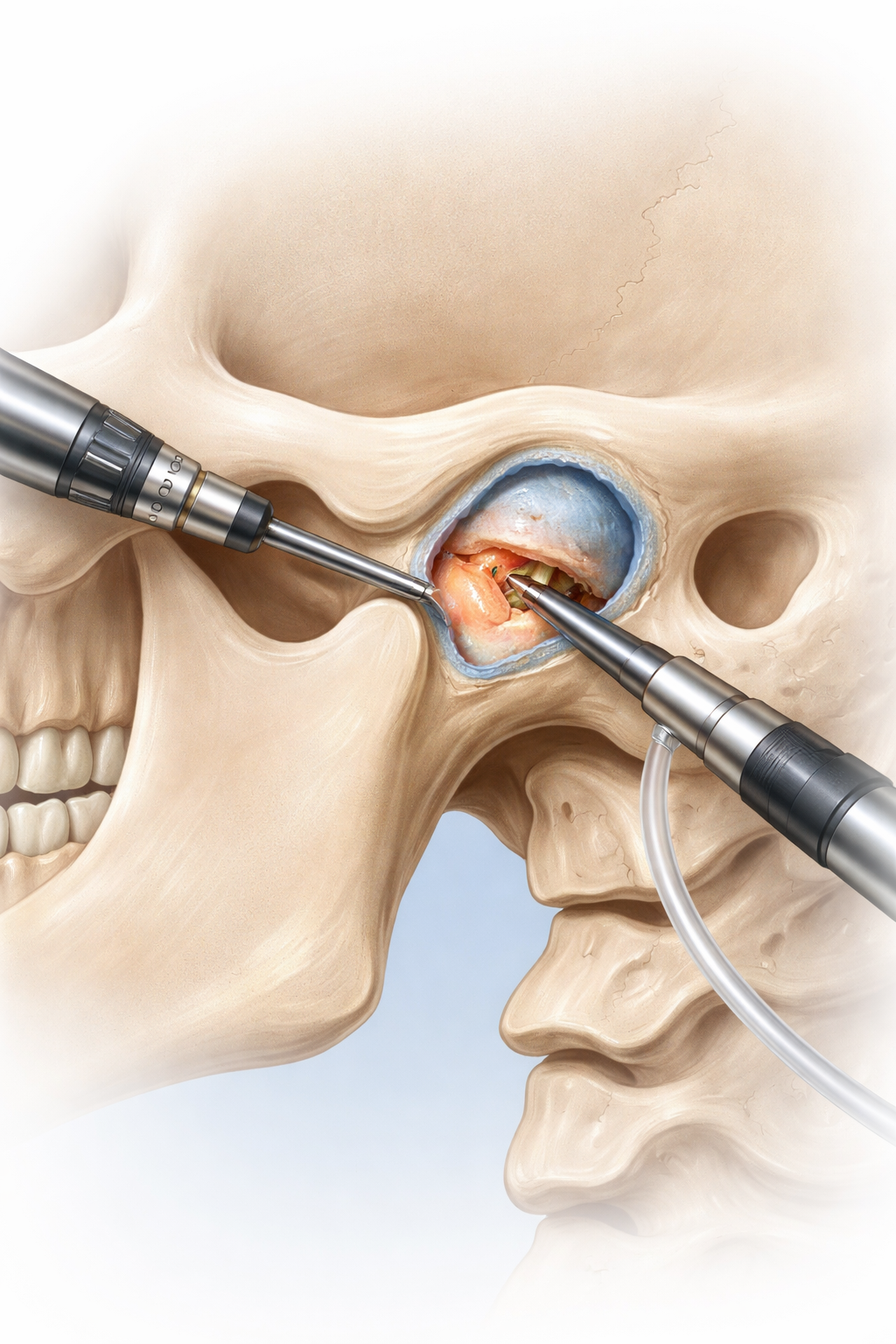
(TR) Kapalı çene eklem ameliyatı, uzun süredir geçmeyen çene ağrısı, kulak çınlaması, baş ağrısı ve çene kilitlenmesi gibi şikayetlerin arkasında yer alan mekanik bozukluğu doğrudan hedef alan ileri düzey bir cerrahi yöntemdir ve literatürde kapalı çene eklem cerrahisi, kapalı çene eklem operasyonu, kapalı temporomandibular eklem ameliyatı veya kapalı TME ameliyatı gibi farklı şekillerde de adlandırılabilir; uluslararası literatürde ise bu yöntem en yaygın olarak artroskopik çene eklem ameliyatı olarak ifade edilir. Bu farklı adlandırmaların tamamı, çene ekleminin açılmadan, minimal girişlerle tedavi edilmesini ifade eder ve temelde aynı cerrahi yaklaşımı tanımlar.
Kapalı çene eklem cerrahisi, minimal invaziv yani dokuya en az müdahale edilen cerrahi yaklaşımlar arasında yer alır ve bu yönüyle yalnızca şikayetleri geçici olarak azaltmayı değil, doğrudan problemin kaynağına inerek çene ekleminin fonksiyonel dengesini yeniden kurmayı amaçlar. Buna karşılık açık çene eklem cerrahisi, daha geniş cerrahi alan gerektiren ve dokuya daha fazla müdahale içeren majör bir cerrahi yaklaşımdır ve bu nedenle iyileşme süreci daha uzun olabilir, hasta konforu farklılık gösterebilir ve komplikasyon riski daha dikkatli değerlendirilmelidir.
Kapalı çene eklem ameliyatı, tıbbi olarak Temporomandibular Eklem (TMJ) artroskopisi olarak adlandırılan ve eklem açılmadan milimetrik girişlerle gerçekleştirilen bir cerrahidir; bu işlem sırasında eklem diski, eklem yüzeyleri ve hareket mekanizması doğrudan görüntülenerek değerlendirilir ve gerekli durumlarda bu yapıların doğal konumu yeniden sağlanır. Artroskopik çene eklem ameliyatı olarak da bilinen bu yöntem, doğru teknikle uygulandığında eklemin doğal hareket düzeninin yeniden kazanılmasına imkan tanır.
Kapalı Çene Eklem Cerrahisinin Temel Yaklaşımı
Prof. Dr. Mustafa Tek’in Tek Clinic bünyesinde uyguladığı kapalı çene eklem cerrahisi yaklaşımı, yalnızca mevcut şikayetleri azaltmaya değil, doğrudan eklem diskinin anatomik konumunu yeniden düzenlemeye ve çene ekleminin biyomekaniğini yeniden kurmaya odaklanır. Bu yaklaşım, geçmişte kapalı çene eklem ameliyatı veya kapalı TME ameliyatı uygulamış ancak teknik zorluklar ve sınırlı başarı oranları nedeniyle bu yöntemden uzaklaşmış birçok cerrahi yaklaşımın ötesinde, sistematik bir tedavi modeli olarak ele alınır.
Prof. Dr. Mustafa Tek’in bu alandaki yaklaşımı yalnızca klinik deneyime değil aynı zamanda güçlü bir uluslararası eğitim sürecine dayanır; Amerika Birleşik Devletleri’nde Icahn School of Medicine at Mount Sinai, New York University ve Lenox Hill Hospital gibi merkezlerde çene eklemi cerrahisi üzerine çalışmış olması, kapalı çene eklem cerrahisinin yalnızca teknik bir işlem değil, ileri düzey bir değerlendirme ve planlama süreci gerektirdiğini ortaya koyar.
Bu nedenle Tek Clinic yaklaşımında primer hedef, mümkün olan her durumda kapalı çene eklem cerrahisi ile eklemin doğal yapısını koruyarak tedavi sağlamaktır.
Çene eklemi rahatsızlıklarının neden olduğu belirtiler
Çene eklemi, mandibula ile kafa tabanı arasında yer alan ve hem kas sistemi hem de sinir ağı ile doğrudan bağlantılı olan bir yapı olduğu için burada ortaya çıkan bir problem çoğu zaman yalnızca çene ile sınırlı kalmaz ve baş, boyun, kulak ve yüz bölgesine yayılan farklı şikayetlerle kendini gösterir; özellikle kronik baş ağrıları, boyun ve omuz gerginliği, kulak çınlaması, yüz bölgesinde basınç hissi ve çiğneme sırasında zorlanma gibi belirtiler çoğu zaman birbirinden bağımsız gibi değerlendirilse de, aslında çene eklemindeki mekanik dengesizlikten kaynaklanabilir ve bu durum çoğu zaman geç fark edilir.
Kapalı çene ameliyatının uygulama gerektirdiği durumlar
Kapalı çene eklem ameliyatı genellikle uzun süredir devam eden ve günlük yaşam kalitesini belirgin şekilde etkileyen durumlarda gündeme gelir çünkü başlangıçta hafif düzeyde hissedilen çene eklemi problemleri zamanla ilerleyerek daha kompleks bir tabloya dönüşebilir; ağız açma kısıtlılığı, çene kilitlenmesi, çiğneme sırasında ağrı, sabahları çenede sertlik hissi, diş sıkma alışkanlığı ve çeneden gelen sesler bu sürecin ilerlediğini gösteren önemli işaretlerdir ve bu noktada kapalı çene eklem cerrahisi önemli bir tedavi seçeneği haline gelir.
Tanı ve değerlendirme süreci
Çene eklemi problemlerinde kalıcı bir sonuç elde edilebilmesi için en kritik aşama doğru teşhistir çünkü her hasta için kapalı çene eklem ameliyatı gerekli değildir ve her çene ağrısı cerrahi gerektirmez; bu nedenle süreç detaylı bir klinik değerlendirme ile başlar ve çene hareketleri, kas dengesi, ağrı noktaları, ağız açıklığı, eklem sesleri ve fonksiyonel kısıtlılıklar ayrıntılı şekilde analiz edilir. Klinik muayene sırasında çene açma-kapama hareketinin seyri, eklemde deviasyon olup olmadığı, çiğneme kaslarının hassasiyeti, kilitlenme öyküsü ve ağrının günlük yaşama etkisi birlikte değerlendirilir.
Klinik muayenenin ardından radyolojik muayene aşaması devreye girer çünkü kapalı çene eklem operasyonu kararı yalnızca şikayetlere göre değil, eklem yapısının ayrıntılı biçimde görüntülenmesiyle verilmelidir. Bu noktada 3D volumetrik tomografi, çene eklemini oluşturan kemik yapıların detaylı olarak incelenmesini sağlar ve eklem başı, kemik yüzeyleri, yapısal düzensizlikler ya da dejeneratif değişiklikler hakkında önemli bilgiler verir. TME MR görüntüleme, özellikle eklem diskinin konumu, diskin yer değiştirme derecesi, eklem içi yumuşak dokular ve sıvı değişiklikleri gibi doğrudan cerrahi planlamayı etkileyen unsurların değerlendirilmesinde kritik rol oynar.
Bunlara ek olarak panoramik röntgen, genel çene yapısının, dişlerin, kemik ilişkilerinin ve eşlik eden başka problemlerin ön değerlendirilmesinde yararlı bir görüntüleme yöntemidir. TME röntgeni ise çene ekleminin temel yapısal görünümünü değerlendirmede ve bazı vakalarda ilk aşama görüntüleme desteği sağlamada kullanılabilir. Tüm bu klinik ve radyolojik veriler birlikte değerlendirildiğinde, kapalı çene eklem ameliyatının gerekli olup olmadığı çok daha net şekilde belirlenir ve her hasta için kişiye özel bir tedavi planı oluşturulur.
Kapalı çene ameliyatının cerrahi uygulama süreci
Kapalı çene eklem ameliyatı sırasında eklem içine küçük girişlerle ulaşılır ve artroskopik sistemler sayesinde eklem doğrudan görüntülenir; bu sayede eklem diskinin konumu, yüzeylerin uyumu ve hareket sırasında oluşan problemler detaylı şekilde değerlendirilir. Artroskopik çene eklem ameliyatı kapsamında gerekli durumlarda disk doğru pozisyonuna alınır, eklem içi yapışıklıklar giderilir ve hareketi kısıtlayan mekanik engeller ortadan kaldırılır ve bu süreçte amaç çene ekleminin doğal hareket düzenini yeniden sağlamaktır.
Cerrahi sürecin başarısı yalnızca işlemin uygulanmasına değil, ameliyatın hangi biyomekanik probleme yönelik planlandığına da bağlıdır. Bu nedenle işlem öncesinde elde edilen klinik ve radyolojik veriler doğrultusunda eklem diskinin durumu, hareket kısıtlılığının nedeni, ağrının kaynağı ve eklem içi yapışıklıkların seviyesi değerlendirilir; ameliyat sırasında da bu planlamaya uygun şekilde eklem içi yapıların serbestleştirilmesi, diskin fonksiyonel konumunun desteklenmesi ve eklemin daha dengeli hareket etmesini sağlayacak müdahaleler yapılır. Böylece kapalı çene eklem cerrahisi yalnızca görüntüleme yapılan bir işlem olmaktan çıkar ve doğrudan tedavi edici bir cerrahi yaklaşım haline gelir.
Ameliyat sonrası iyileşme ve takip süreci
Kapalı çene eklem ameliyatı sonrasında iyileşme süreci genellikle konforlu ilerler çünkü minimal invaziv yaklaşım sayesinde doku hasarı sınırlıdır ve eklem çevresindeki yapılar korunur; hastalar çoğu zaman aynı gün taburcu edilir ve kısa sürede günlük yaşamlarına dönebilir. Ancak kalıcı başarı için kapalı çene eklem cerrahisi sonrası takip süreci büyük önem taşır ve Tek Clinic’te bu süreç kişiye özel egzersiz programları ve düzenli kontroller ile desteklenir.
Ameliyat sonrasında yalnızca cerrahi alanın iyileşmesi değil, çene ekleminin yeniden doğru hareket düzenine adapte olması da önemlidir; bu nedenle hastanın kontrollü çene egzersizleri, beslenme düzeni, eklem üzerine binen yükün azaltılması ve hekim kontrollerine uyumu tedavinin ayrılmaz bir parçasıdır. Özellikle uzun süredir eklem problemi yaşayan hastalarda iyileşme süreci bir rehabilitasyon mantığıyla ele alınır ve bu yaklaşım, ameliyat sonrası elde edilen fonksiyonel kazanımın korunmasına önemli katkı sağlar.
Kapalı çene eklem ameliyatında başarı oranı
Uygulanan cerrahi yaklaşım ve tedavi protokolü birlikte değerlendirildiğinde, uygun hasta grubunda kapalı çene eklem ameliyatı sonrası elde edilen klinik başarı oranlarının %90’ın üzerinde olduğu görülmektedir ve bu durum, kapalı temporomandibular eklem ameliyatı olarak da bilinen bu yöntemin doğru hasta seçimi ve doğru teknik ile uygulandığında etkili bir tedavi seçeneği olduğunu gösterir. Ancak burada belirleyici olan unsur yalnızca ameliyatın adı değil; hastanın doğru değerlendirilmesi, eklem diskinin durumunun doğru analiz edilmesi, cerrahi planlamanın deneyimli bir ekip tarafından yapılması ve ameliyat sonrası takip sürecinin dikkatle yürütülmesidir.
Bu nedenle başarı oranı, tek başına genel bir istatistik olarak değil, doğru tanı, doğru hasta seçimi ve doğru cerrahi uygulamanın doğal sonucu olarak değerlendirilmelidir. Tek Clinic yaklaşımında hedef, yalnızca kısa süreli rahatlama sağlamak değil; çene ekleminin fonksiyonel dengesini yeniden kurarak hastanın günlük yaşam kalitesini kalıcı biçimde artırmaktır.
Kapalı çene ameliyatı ile açık cerrahi yöntemlerin karşılaştırılması
Değerlendirme Kriteri Kapalı yöntem Açık cerrahi
Cerrahi yaklaşım Milimetrik girişlerle gerçekleştirilir Geniş cerrahi açılım yapılır
Doku korunumu Yapılar büyük ölçüde korunur Daha geniş doku etkilenir
Günlük yaşama dönüş Kısa sürede mümkündür Daha kademeli ilerler
Risk profili Daha kontrollü bir süreç sunar Daha yüksek komplikasyon riski içerir
Tedavi sonucunu etkileyen faktörler
Kapalı çene eklem ameliyatı teknik olarak tanımlanmış bir işlem olsa da elde edilen sonuçlar her hastada aynı şekilde ilerlemez çünkü çene eklemi problemlerinin şiddeti, eklem diskinin konumu, kas dengesi, hastalığın süresi ve hastanın tedavi sürecine uyumu gibi birçok faktör bu süreci doğrudan etkiler; bu nedenle kapalı çene eklem cerrahisi sürecinde doğru hasta seçimi, doğru cerrahi planlama ve ameliyat sonrası sürecin dikkatli şekilde yönetilmesi tedavinin başarısında belirleyici rol oynar.
Gallery


